
The War on Police and the Price of Silence
The moment you are silent on injustice is the moment you are complicit in injustice.
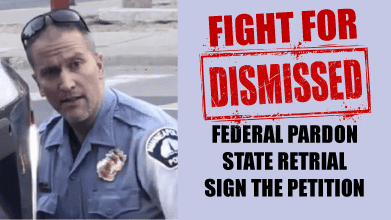
I believe Derek Chauvin did not receive a fair trial. The proceedings took place under intense public pressure, with national Democratic leaders and activists openly warning of violence if the verdict did not match their demands. That atmosphere tainted the neutrality and fairness essential to any legitimate judicial process.
George Floyd’s death was tragic. Yet his extensive criminal history was a relevant component of the case. Derek Chauvin, by contrast, was acting in accordance with his training as a law enforcement officer. That fundamental fact was largely overshadowed by the broader socio-political climate surrounding the trial.
A fair trial requires an impartial jury free from external threats and political intimidation. Given the circumstances, justice demands a federal pardon and a state retrial in a neutral venue. I propose Warroad in Roseau County, Minnesota — far from the media scrutiny and potential unrest of major urban centers. Granting a federal pardon and authorizing a retrial in a calm jurisdiction would address this injustice and help restore confidence that our judicial system can function without undue political influence.
But Chauvin was not the only officer targeted. Three other Minneapolis officers — Tou Thao, J. Alexander Kueng, and Thomas Lane — were also charged, tried, and convicted in connection with the same incident. Their cases unfolded under the same climate of fear, protest threats, and political pressure. The message sent to every rank-and-file officer in Minnesota and across the country was unmistakable: if a high-profile incident occurs, the political class will not stand behind you.
The Case for Dismissal
Derek Chauvin’s current attorney, Gregory Joseph, is actively seeking dismissal of the charges. That request is not radical — it is grounded in the fundamental failures of the original process. The lack of a grand jury is illegal and Tim Walz lacked the proper authority to hand the case over the way he did. When a trial is conducted under explicit threats of violence, when political leaders amplify those threats, and when the atmosphere makes true impartiality impossible, the conviction itself becomes suspect. A dismissal would acknowledge that the proceedings did not meet the basic standards of American justice. It would be a rightful correction, not a political favor. If the evidence and process cannot withstand scrutiny free from mob pressure, then the charges should not stand.
If You Ever Have Been to Court, You Should Be Fighting For This Too
Anyone who has ever been wrongfully arrested by the police or unjustly prosecuted by the state should be screaming from the rooftops for the dismissal of the charges against Derek Chauvin. If you believe the system can destroy an innocent person’s life through political pressure, tainted proceedings, and external threats of violence, then you should understand exactly why this case matters. The same machinery that can be weaponized against a police officer under intense public and political pressure can just as easily be turned against any citizen. Silence in the face of a fundamentally unfair process does not protect the wrongly accused — it endangers them. Those who have felt the weight of a system that failed them should be the loudest voices demanding that Chauvin’s charges be dismissed and that true due process be restored.
This was not an isolated failure of justice. It was part of a broader war on police launched by Democrats in 2020. “Defund the police” was not a fringe slogan — it was embraced by elected officials, activists, and party leaders. Cities reduced budgets, demoralized officers, and watched crime climb. Prosecutors adopted soft-on-crime policies. Career criminals were released with minimal consequences. The same political forces that demanded Chauvin’s conviction also weakened the institutions meant to keep communities safe.
Continued Consequences
Minnesota is still living with the consequences. Rising crime, prosecutors who hesitate to hold repeat offenders accountable, and a culture that treats law enforcement as the problem rather than part of the solution. When officers believe the system will abandon them under political pressure, recruitment suffers, experienced officers leave, and public safety erodes.
Silence in the face of this double standard is complicity. If we accept that a trial conducted under threats of violence is “justice,” we undermine the rule of law for everyone. If we accept that officers following their training can be sacrificed to political narratives, we invite more disorder.
Rocco for State Senate is drawing a clear line. We support the potential dismissal sought by attorney Gregory Joseph. We support a federal pardon and, if necessary, a fair state retrial for Derek Chauvin. We recognize that the other officers in the case were also caught in the same politically charged process. And we reject the war on police that Democrats launched and continue to defend.
Public safety requires officers who know the law will be applied fairly — not according to the loudest political voices. It requires prosecutors who prioritize victims and career criminals over ideology. It requires leaders willing to say what is true even when it is unpopular.
The moment you are silent on injustice is the moment you are complicit in injustice.
Stop voting blue no matter who. Vote Red Instead.
Rocco for State Senate District 65
Resources:
Change.org
Liz Collin:
Derek Chauvin’s fight for a fair trial — and his ‘last line of defense’
Ben Shapiro:
What the media hasn’t told you:
Liz Collin: